


Energy Savings from Indoor Air Quality Technology: What Building Owners Should Know
The air inside your building is doing a lot of work. It affects how occupants feel and how long they stay. It’s also subject to evolving regulations and directly tied to energy consumption. Facility managers are expected to balance it all, and the stakes are high. The wrong IAQ approach can lead to productivity losses, compliance penalties, or tenant turnover.
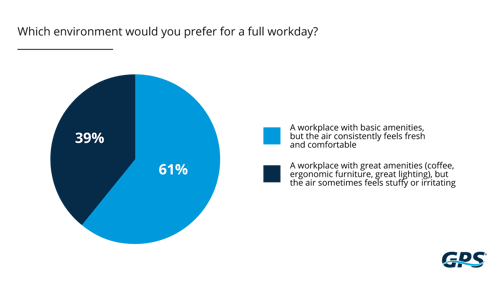
According to the 2026 GPS Air Indoor Air Quality Report, 61% of workers say they would choose a workplace with fresher, more comfortable air over one with better amenities. For building owners and facility managers evaluating IAQ technology, that finding highlights the challenge ahead. Investing in air quality is non-negotiable. The question is which approach actually delivers.
The market has responded to that demand with a growing range of technologies, but those options also bring vendor claims that can be difficult to evaluate without a clear framework.
This guide walks through the evaluation criteria that matter most to building decision-makers, the compliance factors that are often overlooked, and the building-type considerations that should affect any IAQ technology decision.
How to Evaluate IAQ Technology
Before comparing specific technologies, it helps to establish a consistent evaluation framework. The criteria below reflect how facility managers and building engineers actually assess IAQ solutions in practice and the questions worth asking any vendor before a specification decision is made.
Third-Party Validated Performance
Any technology making efficacy claims should be able to point to independent laboratory testing with specific conditions documented, including the standards used, the contaminant type, the concentration tested, and the test environment. General claims without sourced data are not a reliable basis for a capital decision. Ask vendors for the specific study, the lab that conducted it, and the test standards and parameters. If those details are not available, the claim is not verifiable.
Energy Cost Impact
IAQ technology does not exist in isolation from HVAC operations. Some approaches reduce the volume of outside air a building needs to condition, which has a direct effect on size and capacity of equipment as well as energy spend. Others add resistance to airflow, increasing fan energy load. Understanding where a technology sits on that spectrum is essential for total cost of ownership analysis. A solution with a higher upfront cost may deliver a significantly better economic outcome when ventilation energy savings are factored in over a five- or ten-year horizon.
Maintenance Burden
Filter replacement cycles, monitoring requirements, and integration with existing building management systems all affect the long-term operational cost of any IAQ solution. Low first-cost options can carry disproportionate maintenance overhead. Before specifying any technology, facilities teams should map out the full maintenance schedule and confirm it is compatible with their sourcing and staffing capacity.
HVAC Integration Complexity
Technologies that require significant retrofitting or that operate independently of existing HVAC infrastructure add cost and coordination risk. Solutions that integrate with building management systems (BMS) offer more operational continuity and easier performance verification. For buildings already managing complex mechanical systems, the simpler the integration path, the lower the implementation risk.
ASHRAE 62.1 Indoor Air Quality Procedure (IAQP)
This is the compliance factor with the most potential financial upside, covered in depth below. Not all IAQ technologies qualify for the IAQP pathway under ASHRAE 62.1, and that distinction affects both equipment sizing decisions at the design stage and ongoing operating costs. Facility managers and specifying engineers should confirm IAQP eligibility before assuming a technology will support this pathway.
Safety Certifications
Third-party safety validation, particularly around ozone emissions, is a non-negotiable evaluation criterion for any active air cleaning technology deployed in occupied spaces. The specific certification that matters here is UL 2998, covered in the safety section below. Confirming certification status before specification protects both building occupants and building owners from liability exposure associated with unvalidated technology claims.
Active vs. Passive IAQ Treatment: A Framework for Building Owners
Commercial IAQ technologies fall into two broad categories, and the distinction between them has meaningful implications for compliance, energy performance, and building operations.
Passive filtration technologies capture airborne particles as air passes through a filter medium. They are well understood, widely specified, and effective at removing particles within their rated size range. They also add resistance to airflow, which increases the energy demand on fans and air handling equipment. Passive filtration doesn’t reduce a building’s outside air requirements under any current ASHRAE compliance pathway.
Active air cleaning technologies treat air in real time throughout a space. Approaches in this category include needlepoint bipolar ionization (NPBI®), UV-C systems, and photocatalytic oxidation. Active technologies vary significantly in their safety profiles, efficacy data, and integration requirements, which is why the evaluation criteria above matter more than category alone.
Safety Certifications and What They Actually Mean
For building owners evaluating active air cleaning technologies, ozone production in the breathing zone is a legitimate safety concern. Some hard ionization-based technologies generate ozone as a byproduct of their operation. In occupied commercial spaces, that’s not an acceptable tradeoff.
The relevant safety benchmark is UL 2998, the Environmental Claim Validation Procedure for Zero Ozone Emissions from Air Cleaners, required for air cleaners in ASHRAE 241. A technology that is UL 2998 validated has been independently confirmed to produce zero ozone emissions. This is a binary, verifiable data point. When evaluating any active cleaning technology, confirming UL 2998 validation status should be a threshold requirement.
In California, the California Air Resources Board (CARB) sets additional requirements for air cleaning devices sold or operated in the state. Facilities operating in California should confirm CARB compliance alongside UL 2998 validation when specifying any active air cleaning technology.
IAQP Eligibility: The Compliance Factor Most Building Owners Miss
The ASHRAE 62.1 Indoor Air Quality Procedure has been available as a compliance pathway for more than 45 years. Starting with the 62.1-2019 update, the IAQP became more prescriptive, citing contaminants of concern and contamination rates for specific space types. The current standard, ASHRAE 62.1-2025, continues that framework. Under the traditional Ventilation Rate Procedure (VRP), outside air requirements are determined by occupancy and space type. Mechanical systems must be sized to include sufficient outdoor air for contaminant dilution of the expected maximum occupancy of the space. The IAQP pathway changes that calculation.
Under IAQP, buildings that can verify active air cleaning performance reduce outside air loads. That reduction has immediate financial benefit by reducing equipment sizing, energy consumption, and operating costs. See how IAQP works under ASHRAE 62.1.
For building owners pursuing LEED credits, IAQP-eligible active cleaning systems can support those pathways. GPS Air’s technology supports LEED IAQP credit pathways.
See the savings for your building.
Energy Cost Impact: Why Active Cleaning Changes the HVAC Math
The energy case for using the IAQP through active air cleaning is grounded in a straightforward systems-level reality. Outside air must be conditioned before it enters occupied spaces. That means it must be heated, cooled, and in many climates, dehumidified. According to data from the US Energy Information Administration, National Institute of Building Sciences, and the US General Services Administration, 44% of a building’s energy is used for HVAC, with 40% of that being used for outdoor ventilation. This data is typical for schools, auditoriums, houses of worship, and places of assembly.
When active air cleaning is used under IAQP, buildings can reduce outside air requirements substantially. That reduction has two distinct financial effects that compound each other. The first is operational: less outside air to condition means lower energy consumption on an ongoing basis. The second is a first-cost effect that shows up at the design stage: when outside air requirements drop significantly, HVAC equipment can be downsized accordingly. Smaller dedicated outdoor air systems (DOAS), smaller air handling units, and reduced ductwork capacity all translate into capital savings that offset IAQ technology investment.
Conservative modeling for commercial office buildings suggests outside air reductions under IAQP can support energy savings in the range of 30%-50% on ventilation-related loads, though actual results depend on climate zone, occupancy, and mechanical design. See the VRP vs. IAQP ventilation comparison for a detailed breakdown.
Passive filtration is a component of many IAQ strategies, including smartIAQ® systems. The relevant energy comparison for building owners is between the ventilation load that active air cleaning can reduce under IAQP and the full cost picture of the mechanical design, including equipment sizing, operating consumption, and maintenance. That analysis, run against the specific climate and occupancy conditions of a given building, produces a more accurate economic picture than upfront cost alone.
The GPS Air 2026 survey found that 38.4% of workers say the comfort gap between their home and office environments affects their productivity. For building owners, that figure connects directly to the energy conversation. A building that reduces outside air conditioning loads and reinvests those savings into more consistent thermal comfort and air quality is making an operational decision that pays dividends in occupant performance and satisfaction.
Matching IAQ Approach to Building Type: Key Considerations
IAQ technology selection is not one-size-fits-all. Building type, occupancy patterns, regulatory context, and budget structure all shape which approach makes the most sense.
K-12 and Higher Education
Educational facilities face some of the most acute IAQ challenges, with aging HVAC infrastructure and limited capital budgets that make first-cost savings particularly significant. The EPA's Clean Air in Buildings Challenge has increased policy attention on school IAQ, and state IAQ funding programs have emerged in several markets.
The IAQP pathway has demonstrated meaningful savings in educational settings. For example, one K-12 IAQP case study documented a 65-70% reduction in outside air requirements, which translated to nearly $400,000 in projected first-cost savings and an estimated $17,000 to $20,000 in annual energy cost reductions. A university retrofit case study reports savings of $400,000-$900,000 and an accelerated project timeline using the IAQP pathway.
Commercial Office
Return-to-office dynamics have elevated occupant comfort and air quality from facilities concerns to business strategy considerations. LEED certification has grown as a tenant retention and ESG reporting tool. IAQP economics are particularly compelling in high-occupancy office environments where outside air conditioning represents a large share of total HVAC load.
Places of Assembly
Houses of worship, auditoriums, and similar assembly spaces present a distinct IAQP opportunity. These facilities are characterized by intermittent high occupancy — spaces that may sit at low occupancy for most of the week and fill to capacity for services or events. Under the VRP, mechanical systems must be designed for peak occupancy regardless of how often it occurs. The IAQP pathway allows active air cleaning performance to offset that peak-demand sizing assumption, which is where the cost savings materialize. GPS Air's church IAQP case study illustrates the financial impact for a mid-sized house of worship.
How smartIAQ® Enables IAQP Opportunity in Commercial Buildings
One of the most common reasons engineers and building owners hesitate on the IAQP pathway is the assumption that compliance requires a significant overhaul of existing mechanical systems. The architecture of smartIAQ® is designed specifically to remove that barrier.
The smartIAQ® IAQP-enabling air cleaning platform from GPS Air provides the closed-loop monitoring and BMS integration that verifies active air cleaning performance in real time and documents IAQP compliance on an ongoing basis. The platform’s autonomous air cleaning capability means that performance is maintained and documented without requiring continuous manual intervention from facilities staff. This is a meaningful operational consideration for buildings managing lean maintenance teams.
For projects where installation simplicity is a priority, the smartIAQ® GridSet™ brings the IAQP pathway down to its most accessible form. smartIAQ® GridSet is a lay-in ceiling unit designed to drop directly into a standard 2-by-2 T-bar ceiling grid. It doesn’t require ductwork, complex wiring, or structural modifications. Filters are serviceable from the room without ceiling tile removal, and the unit runs both data and power over CAT-5 cabling, simplifying installation in existing spaces.
Each smartIAQ GridSet unit delivers 150 CFM of clean air and covers spaces up to 1,500 square feet at ceiling heights up to ten feet. It operates on demand based on occupancy, conserving energy and extending filter life when spaces are empty, and its LED status indicator provides clear service indication without requiring a dashboard check. For classroom deployments, this means a single unit can support IAQP compliance for a standard classroom without touching the HVAC system at all.
GPS Air's needlepoint bipolar ionization (NPBI®) technology is UL 2998 validated for zero ozone emissions, meeting the threshold safety certification that occupied commercial spaces require. NPBI addresses indoor air quality concerns including particulates, odors, and airborne contaminants. With more than 300,000 installations worldwide, 30-plus patents, and ISO 9001:2015 certification, GPS Air brings a documented scale of real-world deployment to IAQ improvement across building types. The smartIAQ® platform builds on that foundation to deliver the closed-loop monitoring and documentation that IAQP compliance requires.
For building owners ready to evaluate what IAQP compliance and active air cleaning could mean for their specific facility, the conversation starts with understanding where the current mechanical design leaves opportunity on the table.
Tags: