New Ways to Tackle
Old Problems.

Solve your Indoor Air Quality problems efficiently and affordably.

Indoor Air Quality Procedure (IAQP): Performance-Based Ventilation Under ASHRAE 62.1


Everything You Need to Know About Indoor Air Quality Procedure within ASHRAE 62.1

Most commercial buildings are ventilated using a prescriptive formula. Outdoor air is set by occupancy and square footage under the Ventilation Rate Procedure (VRP) in ASHRAE 62.1. It's familiar and widely accepted, but it can result in more mechanical equipment and higher energy costs than necessary.

The Indoor Air Quality Procedure (IAQP) is the performance-based path within ASHRAE 62.1 that has been supported for decades. The premise is that outdoor air isn't the goal; clean air is. If you can clean the air already inside the building, you reduce some of the outdoor air you need to bring in and spend less energy conditioning.

ASHRAE 62.1 defines exactly what that means. The standard specifies “clean air” by defining which compounds in the air need to be regulated, how fast they are generated, and which type of air cleaner engineers can trust. Since the 2019 update to 62.1, ASHRAE has done that work and provided the calculations to make the IAQP calculation straightforward.

The result is a ventilation design that can deliver lower first cost, smaller equipment, and reduced energy consumption while meeting or exceeding indoor air quality standards.

This page is the central IAQP resource: comparison tools, savings calculators, standards guidance, real project results, and application engineering support.



smartIAQ® Systems

smartIAQ gives engineers a standards-based path to cleaner indoor air, reducing outdoor air and conditioning load while providing the verification data to back it up.
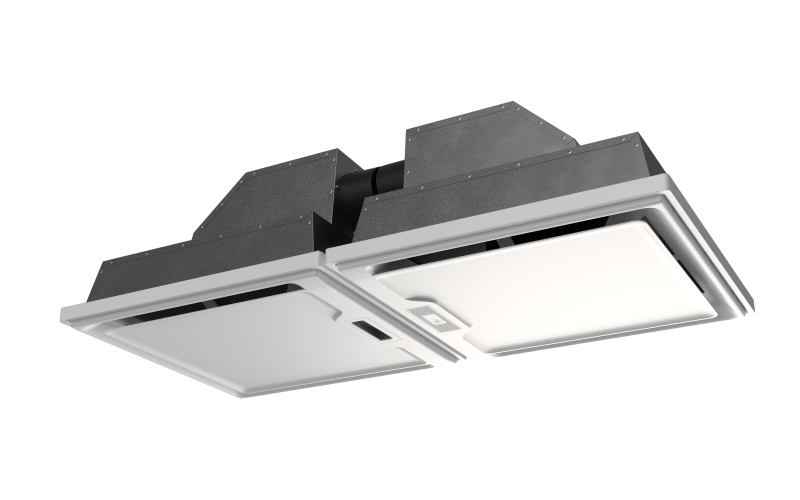
smartIAQ GridSet is the simple lay-in, ceiling air cleaner with closed-loop control for IAQP in single zones.

Why the IAQP Delivers Better Economics Than VRP


In many projects, peak occupancy drives outdoor air requirements and equipment sizing: tonnage, conditioning load, energy recovery, duct sizing, and infrastructure. In humid or hot climates, conditioning outdoor air can represent a significant share of HVAC energy use, roughly 40% of HVAC load, which itself accounts for about 40% of a building's total energy consumption. So outdoor air conditioning is consistently 10 to 20% of a commercial building’s electricity bill.

The IAQP is equal to the VRP under ASHRAE 62.1 when selecting a ventilation strategy. In nearly all municipal mechanical codes, the IAQP can be used as an alternative path to the prescriptive model in the code. When contaminant levels can be controlled and verified, outdoor air volumes can be reduced. That outdoor air reduction flows directly into smaller equipment, simpler system designs, and lower operating costs.

When applied appropriately, IAQP can influence:

  • Equipment sizing and first-cost mechanical scope
  • Long-term energy demand
  • Retrofit feasibility in constrained buildings
  • The need for energy recovery ventilators and DOAS units

Review the Clean Air Ventilation Table: VRP vs. IAQP.
gpsair-smartiaq-church-savings-iaqp-1

The traditional prescriptive method relies on the principle of dilution to keep contaminants under control, meaning high volumes of air are needed and over time that volume dilutes the issues to acceptable levels. An IAQP approach focuses on extracting and neutralizing the contaminants, preferably at the source, which is instantaneous and therefore much faster than waiting on dilution, leading to on average, better indoor air quality.

It’s also worth noting that outdoor air isn't always clean. Wildfire smoke, ozone, and urban pollutants have made clear that more outdoor air is not automatically better air. IAQP ASHRAE guidance requires engineers to investigate outdoor air quality conditions and design around both indoor and outdoor contaminant sources, providing a more complete approach to managing air quality.

How IAQP Works Under ASHRAE 62.1

Are bad odors threatening your reputation?

Since the 2019, 2022, and 2025 updates to ASHRAE 62.1, the IAQP has become a tightly defined, prescriptive procedure. ASHRAE specifies:

  • Which design compounds to evaluate — defined in Standard 62.1 Table 6-5
  • The concentration limit for each compound — defined in Table 6-5, sourced from recognized health authorities
  • Generation rates by space type — provided through the ASHRAE IAQP Calculator (D-86925)
  • Mixture effects — compounds that interact are grouped in Table 6-6, with a combined exposure test
  • Air cleaner validation requirements — devices must be listed to UL 2998 for safety, rated by third parties to ASHRAE 145.2 for gas-phase removal and ASHRAE 52.2 for particles.

The IAQP calculation takes these inputs and uses the mass-balance equation to determine the minimum outdoor air required to keep contaminant concentrations within limits, accounting for air cleaning performance. The ASHRAE calculator and the smartIAQ Calculator automate that process.

IAQP designs must also be verified after construction. Section 7.3 of ASHRAE 62.1 requires objective measurement of design compounds in the completed building to confirm that design limits are met. The standard also requires a subjective evaluation confirming that at least 80% of occupants find the indoor air acceptable.

Ultimately, having flexibility in how much outdoor air is required unlocks mechanical designs - providing engineers options to select equipment and size systems to deliver productivity- more efficient and cost effective designs for clients. Experienced IAQP designers describe the benefits of design freedom to directly lower humidity, reduce system weight, and/or have a more broad catalog of conditioning equipment to select from for performance and budget benefits.

IAQP in Practice: Real Project Results

The IAQP is not all-or-nothing. ASHRAE 62.1 allows it to be applied selectively by zone or system, so engineers can target the spaces where outdoor air requirements are highest and savings are greatest.
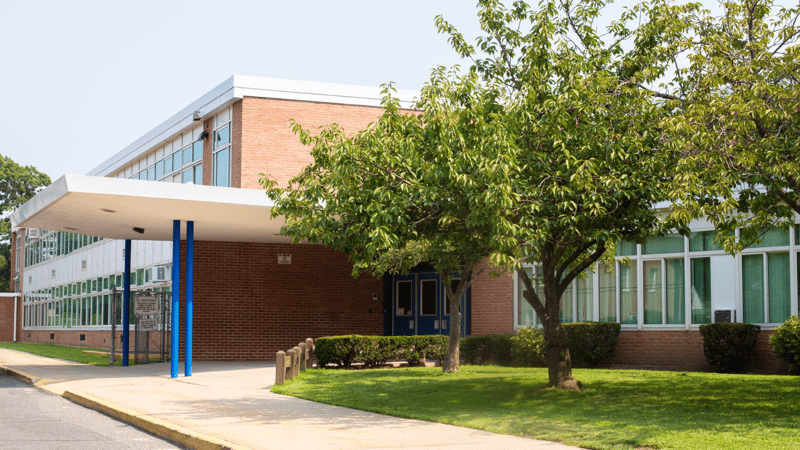
Elementary School

K–12 Schools

A Texas school district applied the IAQP to a new 20-classroom, 11-lab building.

Outdoor air requirements dropped by 65–70%, enabling dramatically smaller DOAS capacity across the project and saving nearly $400,000 in first cost, with an estimated $17,000–$20,000 in annual energy savings.
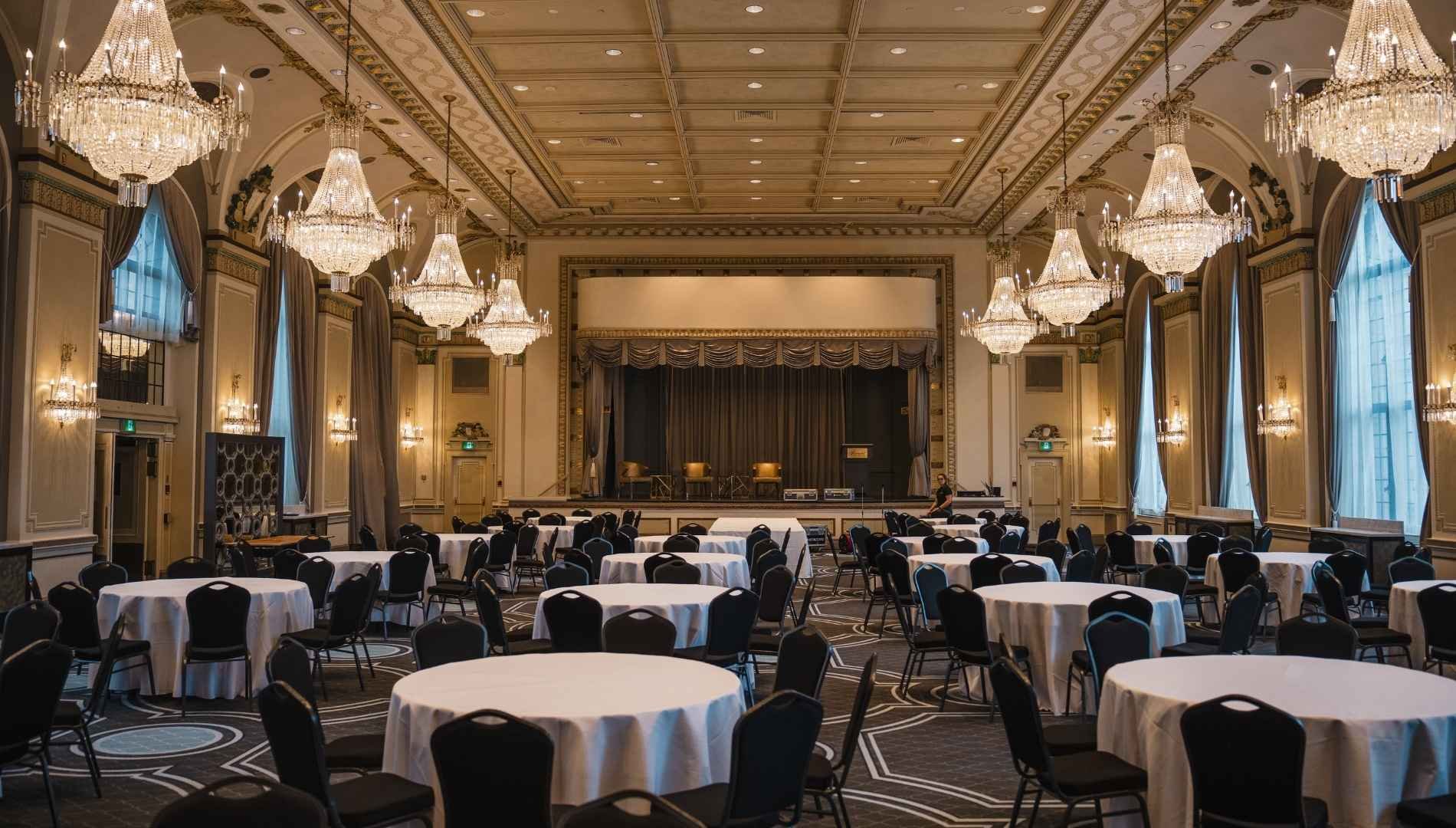
Hotel ballroom for hotel IAQP case study showing lower capital costs.

Hospitality

A large conference hotel in the Southeast faced more than 43,000 CFM of required outdoor air under VRP, more than the available roof and mechanical space could support.

IAQP reduced that load by nearly 50%, eliminated the need for most energy recovery ventilators, and delivered $710,000 in estimated equipment savings plus $25,000 per year in reduced energy costs.

University classrooms renovated from office space with IAQP.

University Retrofits

A Texas university converting office space to classrooms faced $500,000–$1,000,000 in mechanical upgrades and a one-year timeline under VRP.

IAQP reduced outdoor air from 4,770 CFM to 1,500 CFM, eliminated the DOAS requirement entirely, and compressed the project schedule to three months.

gpsair-smartiaq-church-ventilation-iaqp

Houses of Worship and Assembly Spaces

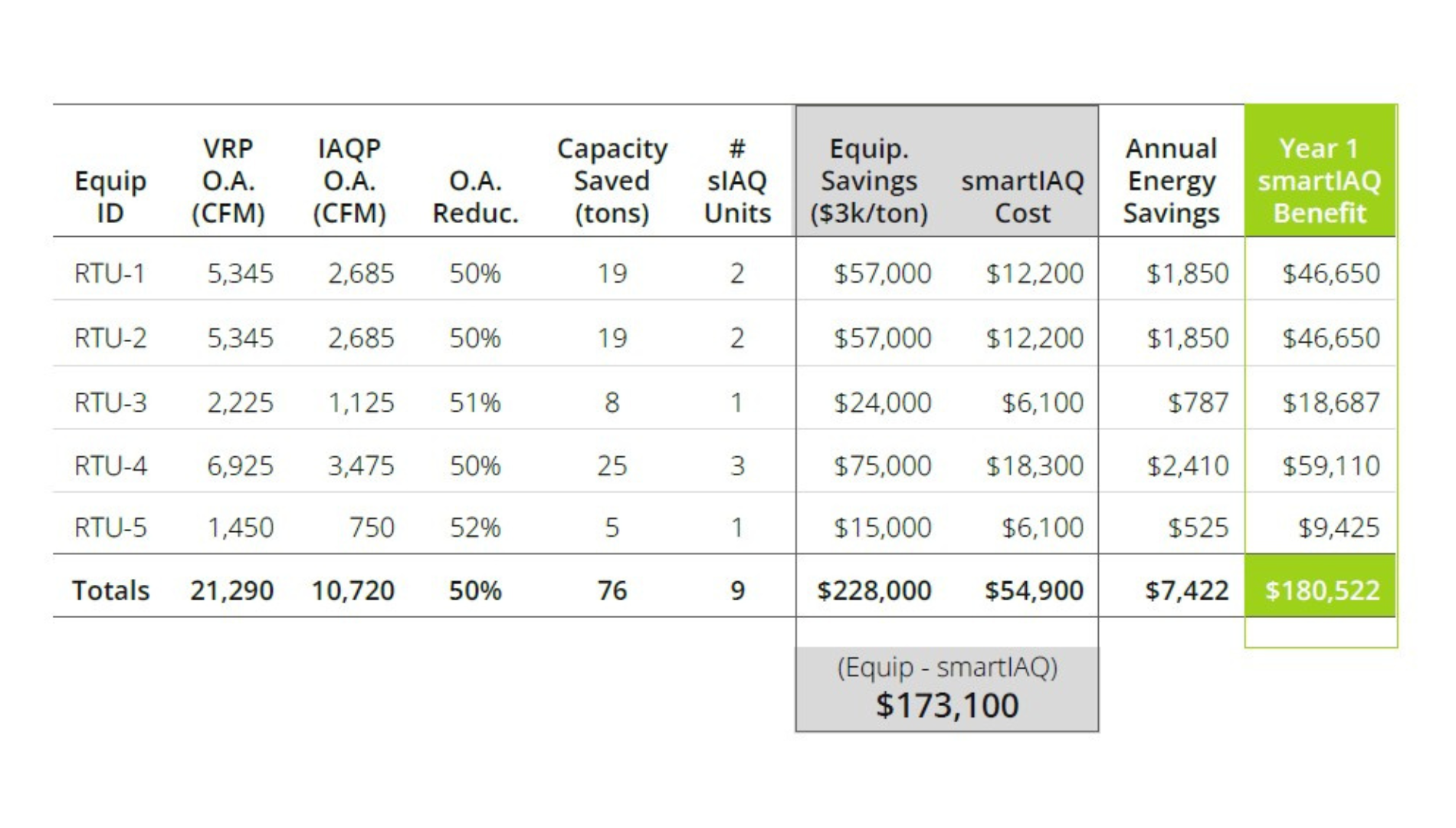
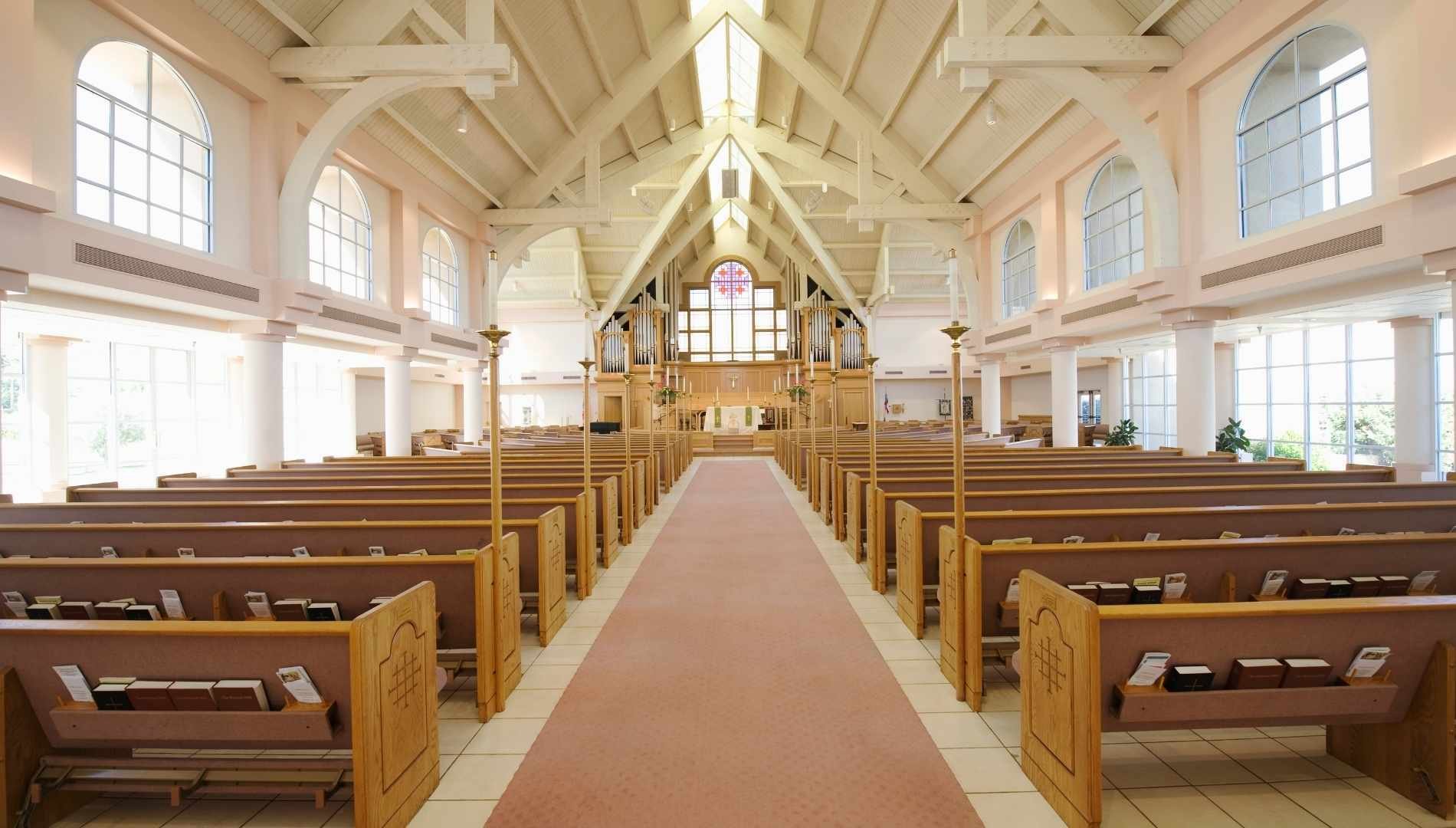
A Texas church over budget on new construction used IAQP to cut outdoor air in half.

The result was 76 tons of HVAC capacity eliminated, $173,000 in first cost savings, and lower ongoing energy costs, with no changes to ductwork.


Equivalent Outdoor Air: Understanding IAQP Performance

Are invisible pollutants compromising your indoor air?

Skip to main content
 

Under the VRP, clean air means outdoor air. The assumption is that bringing in enough outside air will dilute indoor contaminants to acceptable levels. The IAQP challenges that assumption and replaces it with targets and math.

When a validated air cleaning system removes contaminants from recirculated air, it produces what the IAQP treats as equivalent clean air. The mass-balance equation accounts for both streams: the outdoor air coming in and the cleaned recirculated air passing through the air cleaning system. Both contribute to keeping design compound concentrations below their limits. Both count.

This is how the IAQP justifies outdoor air reduction. It isn't a loophole or an assumption, it's a calculation. The engineer runs the mass-balance for each of the 14 design compounds defined in ASHRAE 62.1 Table 6-5, confirms that concentrations stay below the established limits with the proposed combination of outdoor air and air cleaning, and documents the result.


The air cleaning system's contribution depends entirely on its validated removal efficiency for each compound. This is why ASHRAE 62.1 requires air cleaners used in IAQP designs to be tested to ASHRAE 145.2 for gas-phase compounds and ASHRAE 52.2 for particles, and manufacturer claims alone do not count. Third-party validated efficiency data is what goes into the equation and determines how much equivalent outdoor air the system actually delivers.

For owners and reviewers who find contaminant math abstract, translating air cleaning performance into equivalent outdoor air terms makes the tradeoff concrete: a system cleaning 500 CFM of recirculated air at defined efficiencies is delivering measurable clean air to the space, reducing the outdoor air volume needed to achieve the same result. IAQP does not eliminate ventilation. It replaces the assumption behind VRP with a documented, verified calculation.

Professional Engineer Support for Ventilation Efficiency

Our Application Engineering team helps you evaluate ventilation strategies, reduce outdoor air requirements, and document IAQP-based designs, with guidance tailored to your building type, system, and goals at every stage of the project.

High-impact zones typically include:

  • Classrooms and lecture halls

  • Auditoriums, gyms, theaters, arenas

  • Houses of worship and assembly spaces

  • Hospitality common areas

  • Fitness spaces and entertainment venues

  • Meeting rooms and conference centers

IAQP, LEED v5, and ASHRAE Standards Alignment

IAQP is grounded in established standards that govern ventilation, filtration, and air cleaning performance. Together, these frameworks define how clean air is measured, validated, and safely delivered in commercial environments.

LEED v5

Under LEED v5, IAQP is recognized as an acceptable compliance path under the Fundamental Air Quality prerequisite, with ASHRAE 62.1-2022 as the referenced standard.

IAQP-based designs can support multiple credits, including enhanced air quality, continuous IAQ monitoring, and resilient spaces.

Learn more about LEED v5 and IAQP

ASHRAE Standard 90.1

By reducing outdoor air below certain thresholds, IAQP designs may eliminate energy recovery ventilation requirements triggered under ASHRAE 90.1, removing equipment, complexity, and service costs from the project.

When outdoor air falls below 20% of total system airflow, Table 6.5.6.1.2-1 in Standard 90.1 removes the ERV requirement in many climate zones.

Learn more about IAQP and ASHRAE 90.1

ASHRAE Standard 52.2

Standard 52.2 defines the method for rating air filters based on particle removal efficiency. This results in a MERV rating, derived from single-pass testing that evaluates how effectively filters capture particles of specific sizes.

MERV ratings are required for air cleaners under ASHRAE 62.1, including those targeting PM2.5 and ultrafine particles.


ASHRAE Standard 145.2

Standard 145.2 establishes a testing protocol for evaluating how effectively an air cleaner removes gaseous contaminants through single-pass testing.

This “mechanical removal” approach is conducted by third parties and is referenced by ASHRAE 62.1 IAQP as a primary method for validating gas-phase air cleaning performance.

UL 2998 Certification

UL 2998 is a zero-ozone emissions validation used to demonstrate that an air-cleaning product does not produce harmful ozone byproducts. It is a recognized third-party validation for air-cleaning devices and is often used as a safety credential for technologies such as electronic air cleaners and UV-based systems.

Positioning air cleaning solutions with UL 2998 certification strengthens credibility with building owners, engineers, and regulatory stakeholders.


Frequently Asked Questions About the Indoor Air Quality Procedure (IAQP)

What is the Indoor Air Quality Procedure (IAQP)?

The IAQP is the performance-based ventilation path within ASHRAE 62.1. Rather than prescribing outdoor air rates by occupancy and area, IAQP designs to specific contaminant limits, using a combination of outdoor air and validated air cleaning to keep indoor concentrations within health-based thresholds defined by the standard.

How does IAQP differ from the Ventilation Rate Procedure (VRP)?

VRP is a prescriptive method that sets outdoor air rates based on occupancy and floor area. IAQP is the performance-based alternative within ASHRAE 62.1 that designs to contaminant limits and allows validated air cleaning to reduce outdoor air requirements. Both are compliant paths under ASHRAE 62.1.

Does IAQP require engineers to identify all the contaminants themselves?

No. ASHRAE 62.1 defines the design compounds, concentration limits, and generation rates by space type. Since the 2019 update, these are prescribed in the standard and built into the ASHRAE IAQP Calculator. The GPS Air IAQP Ventilation Table simplifies this further into a lookup-style format comparable to the VRP.

What is an IAQP calculation?

An IAQP calculation uses ASHRAE 62.1's mass-balance equations to determine the minimum outdoor airflow required to keep each design compound below its concentration limit, accounting for the air cleaning system's removal efficiency. The smartIAQ Calculator automates this process and produces documentation suitable for drawings and specifications.

What does "equivalent outdoor air" mean in an IAQP design?

Equivalent outdoor air refers to the effective clean air delivered by a validated air cleaning system, expressed in terms comparable to outdoor ventilation rates. In an IAQP design, air cleaning performance is factored into the mass-balance equation, allowing documented outdoor air reduction when contaminant levels can be maintained within limits.

Does IAQP comply with ASHRAE 62.1?

Yes. IAQP is explicitly defined within ASHRAE 62.1 as an alternative compliance path to the standard, not just to the VRP.

Can IAQP reduce HVAC equipment sizing and energy costs?

Yes, particularly in spaces where peak occupancy drives conditioning loads. Reducing outdoor air directly reduces the tonnage required to condition it, resulting in smaller equipment, simplified designs, and lower energy use. GPS Air case study results range from $173,000 to $710,000 in first-cost savings per project.

What is the post-occupancy verification requirement for IAQP?

ASHRAE 62.1 Section 7.3 requires objective measurement of design compounds and PM2.5 in the completed building to verify that concentration limits are met. The standard also requires a subjective evaluation confirming that at least 80% of occupants find the indoor air acceptable. smartIAQ's integrated sensors support ongoing monitoring and compliance traceability beyond that initial verification.

Does IAQP qualify for LEED v5 credits?

LEED v5 recognizes IAQP under the Fundamental Air Quality prerequisite when designed to ASHRAE 62.1-2022. From there, smartIAQ can support additional credits for enhanced air quality, IAQ monitoring, and resilient spaces.

How does IAQP relate to ASHRAE Standard 241?

ASHRAE 241 is a separate standard addressing infection risk management through equivalent clean airflow targets. It defines its own Appendix A testing protocol for air cleaners used in infection-control designs, distinct from the validation requirements for IAQP air cleaners under 62.1. smartIAQ is tested to both, making it possible to meet IAQP requirements under 62.1 and equivalent clean airflow targets under 241 at the same time.