



Many commercial buildings have some form of indoor air quality monitoring. But having a system that monitors is different from having a technology that acts on what it measures. A dashboard that reports elevated PM2.5 or TVOC levels is only as useful as the person who reads it and responds. Since many buildings operate with lean facilities teams and variable occupancy patterns, they may not be able to respond quickly or at all.
smartIAQ® takes a different approach. It senses indoor contaminants, activates cleaning when levels rise, verifies the result, and modulates output back down when targets are met, without manual input at any step. The outcome is verified clean air, regardless of whether or not teams have the bandwidth to act.
What Autonomous Air Cleaning Actually Means
An autonomous air cleaning system measures indoor contaminant levels, activates cleaning in response to what it detects, confirms the result through continuous measurement, and adjusts output accordingly.
Often compared to air quality monitors or passive filtration systems, smartIAQ actually doesn’t fit in either category. Air quality monitors provide real-time visibility into contaminant levels, but they don’t clean the air. Acting on what they show requires a person to make a decision and take a separate action. Passive filtration systems clean air that passes through a filter medium, but they do so at a fixed rate regardless of actual contaminant levels. They have no sensor feedback loop and no way to adjust output to match changing conditions. This creates an assumption that contaminants are addressed when they may not be, and it can waste filter life when contaminants are low or rooms are unoccupied.
smartIAQ is an air cleaner that uses monitoring to operate autonomously and produce documented, verified clean air.
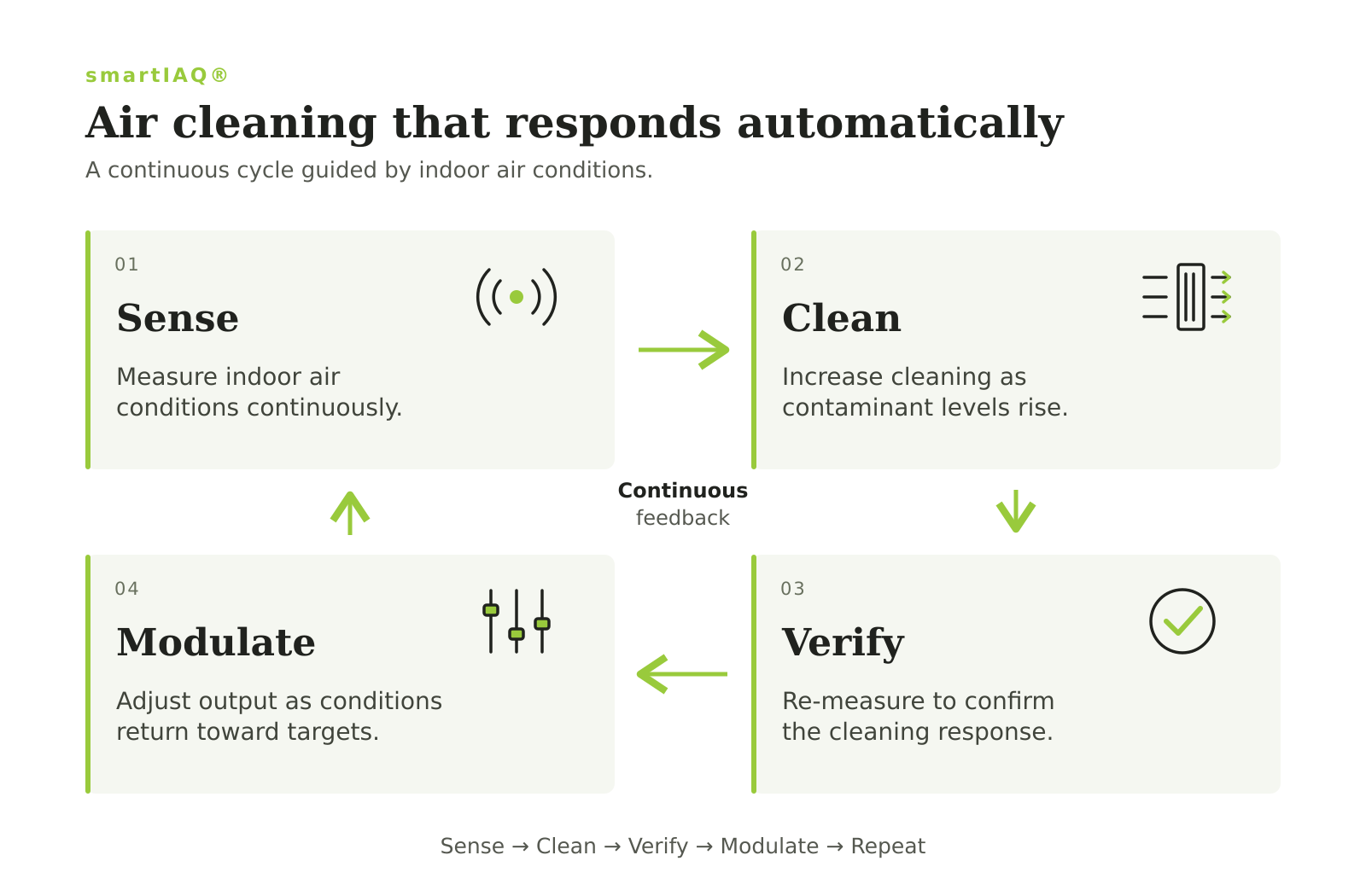
The Closed-Loop Cycle: How smartIAQ Operates Without Human Intervention
The smartIAQ platform runs a continuous four-step cycle that responds to actual building conditions.
Step 1: Sense
Integrated solid-state sensors measure CO2, PM2.5, PM10, TVOCs, formaldehyde, and NOx continuously. No manual calibration is required. The sensor data is the real-time picture of what occupants are actually breathing.
Step 2: Clean
When a contaminant threshold is crossed, smartIAQ activates cleaning. The system scales CFM output proportionally to the detected load, drawing air through its complete filter for particles, VOCs & formaldehyde, tested to ASHRAE 52.2 and 145.2 standards. Needlepoint Bipolar ionization (NPBI®) operates as an additional air cleaning layer within the platform by contributing to particle agglomeration and odor reduction alongside filtration.
Step 3: Verify
Sensors continuously measure during and after the cleaning cycle. The system confirms that contaminant levels are returning toward target before modulating output.
Step 4: Modulate
When contaminants return to target, the system scales back down, which preserves filter life and reduces energy consumption during low-demand periods. CO2 sensing also enables occupancy-based modulation: the system idles when spaces are unoccupied and ramps when occupancy increases.
The system connects to BMS systems through BacNet to log performance data continuously creating an auditable record. It documents what the sensors measured, how the system responded, and what contaminant levels were over time, which is what IAQP alignment and outdoor air reduction documentation requires.
What the Sensors Are Actually Measuring
smartIAQ monitors the five contaminants of concern named in ASHRAE 62.1, plus CO2 , NOx and temperature.
CO2 is the primary occupancy proxy. Rising CO2 indicates increasing metabolic load from occupants and correlates with accumulation of other occupant-generated contaminants. smartIAQ uses CO2 to regulate operation based on actual occupancy. This avoids unnecessary energy use when spaces are empty.
PM2.5 is fine particulate matter at 2.5 microns or smaller. It penetrates deep into the respiratory system and is the particle size associated with the most significant health risk in indoor environments.
PM10 covers coarser particles up to 10 microns. It’s relevant to dust, pollen, and larger airborne debris in commercial spaces.
TVOCs (total volatile organic compounds) indicate off-gassing from building materials, cleaning products, furnishings, and occupant activity. Elevated TVOC levels are common in recently renovated spaces and in commercial kitchens, laboratories, and high-traffic areas.
Formaldehyde is a specific VOC of concern named in ASHRAE 62.1. It off-gasses from adhesives, composite wood products, and finishes, and is present in many commercial building environments at concentrations worth monitoring.
NOx reflects combustion-related pollutants, relevant in urban locations, buildings near loading docks, and spaces with direct outdoor air intake near traffic.
How the System Responds: From Detection to Cleaning
smartIAQ’s self-adjusting cycle scales cleaning output proportionally to detected contaminant load. When levels rise, output increases. When levels return to target, output modulates down. The system does not run at a fixed rate regardless of conditions, which distinguishes it from passive filtration and from monitoring-only systems that require manual intervention to change operating parameters.
It automatically generates filter end-of-life indications and air quality alerts to give facilities actionable information.
Autonomous Air Cleaning and the ASHRAE 62.1 Indoor Air Quality Procedure (IAQP)
The ASHRAE 62.1 IAQP pathway is a performance-based approach that allows buildings to reduce outdoor air requirements when verified active air cleaning is in place. The Indoor Air Quality Procedure is a 45-year-old ASHRAE 62.1 compliance pathway that became significantly more prescriptive following updates in ASHRAE 62.1, 2019 through 2025.
ASHRAE 62.1, as originally designed, is open-loop. If conditions assumed in the ventilation design change, the design may no longer meet its targets without any mechanism to detect or correct the problem. So, when occupancy increases or contaminant sources change, equipment performance may decrease. Without continuous monitoring and response, the design relies on static calculations that may or may not reflect actual building performance at any given time.
Closed-loop monitoring is not required by ASHRAE 62.1. It is a smartIAQ differentiator that turns a static IAQP design into a living, documented compliance record. When conditions change, smartIAQ detects the change, responds, and logs the response. For more on how smartIAQ enables the IAQP pathway, GPS Air’s technical overview covers the sensor architecture, control logic, and documentation output in detail.
ASHRAE Standard 241, Control of Infectious Aerosols, addresses the open-loop problem specifically for infection-risk management, requiring that air cleaning performance in infection-risk contexts be verified and documented.
|
Ventilation Rate Procedure |
Indoor Air Quality Procedure |
|
|
Outdoor air basis |
Peak occupancy, space type, area |
Contaminant accumulation in breathing zone |
|
Credit for active air cleaning |
None |
Yes, with verified performance |
|
Monitoring required |
No |
Recommended for ongoing compliance |
|
Documentation |
Design-phase calculation |
Varies by solution; continuous with closed-loop systems like smartIAQ |
|
Equipment sizing impact |
Fixed to VRP outdoor air volume |
Can be right-sized around reduced outdoor air |
For a more complete VRP vs. IAQP comparison, view our comparison table.
The Energy Case: How Verified Clean Air Reduces HVAC Operating Costs
The energy savings from IAQP-based outdoor air reduction follow directly from the compliance mechanism. When verified air cleaning allows a building to condition less outdoor air, the HVAC load associated with heating, cooling, and dehumidifying that air drops accordingly.
According to the U.S. General Services Administration, HVAC accounts for 44% of commercial building energy consumption, with 40% of that load tied to conditioning outdoor ventilation air. That makes outdoor air reduction the single most effective energy intervention available in commercial building operations. When smartIAQ’s continuous monitoring verifies that IAQP design targets are being maintained, the outdoor air reduction is documentable and sustained rather than assumed.
Equipment right-sizing in new construction and retrofit projects produces a separate, additive first-cost benefit. In one university retrofit, shifting from VRP to IAQP with smartIAQ dropped outside air requirements from 4,770 CFM to 1,500 CFM, and eliminated the need for a 25-ton dedicated outdoor air system entirely. The project stayed on schedule instead of waiting 12 months for equipment that was no longer needed. For the full methodology, see how the IAQP works in ASHRAE 62.1.
See the savings for your building
Installation and BMS Integration: Fitting Into an Existing Building
Integration complexity is a common concern for engineers and facilities teams evaluating smartIAQ. The platform is designed to fit into existing building infrastructure so facility leaders don’t need new mechanical work to enable it.
smartIAQ integrates with building management systems via BACnet, the most widely deployed BMS communication protocol in commercial buildings. Air quality performance data lives in the same operational environment as every other building metric, without requiring a separate monitoring dashboard or parallel reporting system.
Three platform configurations address different building types and HVAC configurations.
smartIAQ GridSet™ is designed for single-zone retrofit in classrooms, conference rooms, and similar spaces. It lays into a standard 2-by-2 T-bar ceiling grid without ceiling or ductwork modification.
smartIAQ Distributed deploys individual units per zone or room, independent of the central HVAC system. It’s well-suited for buildings where central infrastructure can’t support a side-stream installation.
smartIAQ Centralized installs as a side-stream to an existing AHU, delivering IAQP-compliant air cleaning and documentation across multiple zones from a single unit. For buildings with centralized mechanical infrastructure, this configuration provides whole-floor or multi-zone coverage with a single integration point.
smartIAQ is not a standalone air quality monitor. It is an air cleaner. The monitoring enables the autonomous cleaning cycle and generates IAQP documentation, providing closed loop control.
For engineering and specification-phase evaluation, GPS Air’s Application Engineering Team and the smartIAQ Project Builder support project-specific evaluation, including calculating IAQP-eligible outdoor air reductions and projected equipment savings for specific building configurations.
Frequently Asked Questions About Autonomous Air Cleaning
What is autonomous air cleaning?
Autonomous air cleaning is a closed-loop system that continuously senses indoor air quality, activates cleaning when contaminants rise above target levels, verifies the result through re-measurement, and modulates output back down when targets are met. The self-adjusting cycle runs without manual input. It produces verified clean air, as opposed to a monitoring dashboard that requires someone to act on what it shows.
How does smartIAQ operate without manual intervention?
smartIAQ’s integrated solid-state sensors continuously measure CO2, PM2.5, PM10, TVOCs, formaldehyde, and NOx. When a threshold is crossed, the system activates filtration and scales CFM proportionally to the detected load. Sensors re-measure during and after the cleaning cycle. When contaminants return to target, output modulates back down to preserve filter life. The system logs all performance data continuously, and requires no manual input.
How does autonomous air cleaning save energy?
The energy savings come from IAQP-based outdoor air reduction. When smartIAQ’s continuous monitoring verifies that active air cleaning is maintaining IAQP design targets, the building can condition less outdoor air than the Ventilation Rate Procedure would require. According to the U.S. GSA, HVAC accounts for 44% of commercial building energy, with 40% of that load tied to conditioning outdoor ventilation air. Reducing that load is the highest-leverage energy intervention available to commercial building owners.
Does smartIAQ work with my existing HVAC or building automation system?
smartIAQ supports BACnet and Modbus connectivity for integration with existing building management systems. The platform doesn’t require new mechanical infrastructure to operate. smartIAQ GridSet installs in a standard 2-by-2 T-bar ceiling grid without ductwork modification. Distributed and centralized configurations address larger zones and AHU-served spaces. For project-specific compatibility, GPS Air’s Application Engineering Team can confirm the right configuration for a given building.
Is autonomous air cleaning safe? Does it produce ozone?
GPS Air’s NPBI technology is UL 2998 validated for zero ozone emissions, independently confirmed not to exceed five parts per billion of ozone during operation. smartIAQ filtration is tested to ASHRAE 52.2 and 145.2 standards for single-pass removal of particles and gaseous contaminants. UL 2998 is the certification the EPA recommends when evaluating any bipolar ionization device for occupied spaces.
Does smartIAQ qualify for LEED or WELL credits?
GPS Air supports LEED IAQP credit pathways and supports WELL Building Standard certification. For project-level guidance on how smartIAQ fits within a LEED or WELL certification strategy, see GPS Air’s LEED IAQP resource.