What if you could improve classroom air quality and reduce your mechanical budget?

Education facilities face a unique combination of air quality challenges. Classrooms are designed for maximum occupancy, which drives outside air requirements high. Locker rooms, gymnasiums, and recreational facilities generate persistent odors that travel through shared HVAC systems. Outdoor particulate pollution, including vehicle exhaust from bus loops and nearby roadways, enters through ventilation and recirculates through aging equipment.
In high-density spaces, from elementary classrooms to large university lecture halls, poor air quality contributes to absenteeism and asthma rates. University dormitories introduce a host of challenges, including humid conditions and limited ventilation that can allow airborne mold spore counts to approach outdoor levels.
A 2020 Government Accountability Office report found that 41% of school districts needed to update or replace HVAC systems in at least half of their schools, making it the most common school infrastructure need nationally. The EPA’s Clean Air in Buildings Challenge lists schools as a priority sector for indoor air quality upgrades, reflecting federal recognition of the widespread infrastructure gap in educational facilities.
For facility leaders, the challenge is solving this issue expediently within the constraints of capital budgets and aging mechanical infrastructure. Conventional methods don’t meet the moment.
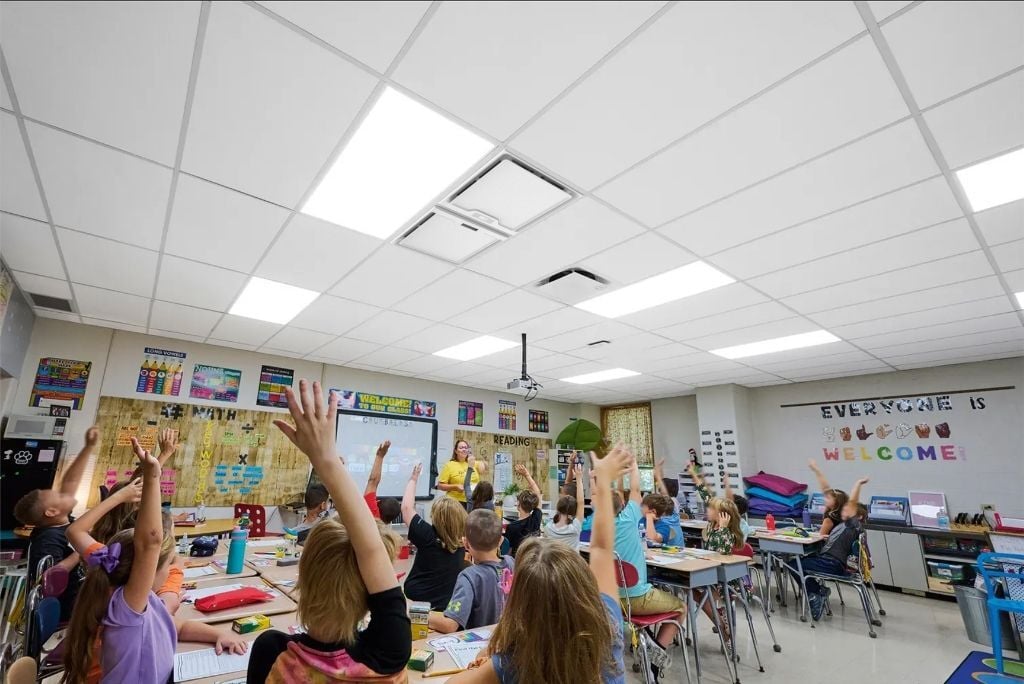
ASHRAE 62.1 and the ASHRAE 62.1 IAQP pathway provide standards for meeting ventilation compliance with methods that clean air and reduce the burden on budgets. The IAQP is a performance-based alternative to the Ventilation Rate Procedure (VRP). Where VRP prescribes a fixed volume of outside air based on occupancy type and space area, IAQP models contaminant accumulation in the breathing zone and allows buildings to substitute verified active air cleaning for a portion of the outside air that would otherwise be required.
To meet outside air requirements under VRP in educational settings, schools typically must specify larger equipment or costly dedicated outdoor air systems (DOAS). The IAQP pathway can reduce those requirements by 50% or more, allowing HVAC teams to specify smaller equipment at the design stage and lower energy costs on an ongoing basis.

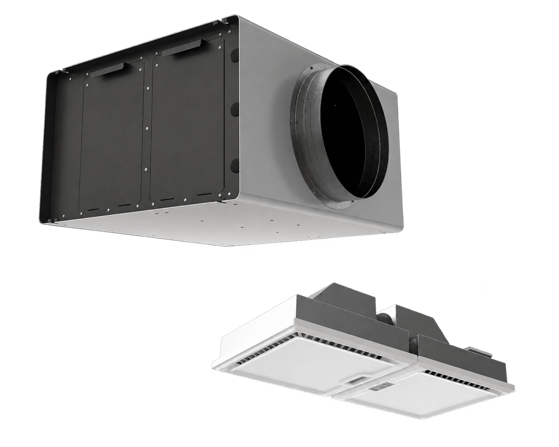
The smartIAQ Distributed configuration delivers in-room and multi-zone air cleaning for up to four spaces, independent of central HVAC infrastructure, making it well-suited for spaces where ductwork modification isn’t practical.
For facilities with a centralized AHU serving multiple zones, the smartIAQ Centralized configuration provides a single-point path to IAQP compliance. Side-stream installation requires no ductwork modification.
GPS Air’s Needlepoint Bipolar Ionization (NPBI) soft ionization technology addresses school air quality challenges while reducing the burden on facility teams and electrical systems.
NPBI uses bundled carbon fiber emitters to generate a dense, ion-rich environment distributed through existing HVAC ductwork. Positive and negative ions travel with conditioned air into occupied spaces, where they interact with odor-causing molecules, certain airborne bacteria and viruses, and airborne particles. Units draw less than 15 watts of power and are autocleaning, so no routine maintenance is required.
All GPS NPBI products are UL 2998 validated for zero ozone emissions, meaning they’re independently confirmed not to exceed five parts per billion of ozone during operation. The EPA recommends UL 2998 certification for any bipolar ionization device deployed in occupied spaces.
The right IAQ solution for a school or university depends on project phase, building configuration, and budget structure. The questions below provide a practical decision framework before engaging a vendor or specifying engineer.
IAQP applies to most ASHRAE 62.1 spaces, and classrooms and high-occupancy educational spaces tend to see the strongest economic benefit due to higher population densities and correspondingly high VRP outside air requirements. The first step is running a project-level IAQP calculation. Inputs needed include building size and space types, design occupancy, existing HVAC configuration, and climate zone.
For new construction projects, IAQP feasibility modeling is most valuable at the schematic design phase, before equipment is sized and specified. That’s the best way to achieve the first-cost savings this pathway offers. For retrofit projects, it’s best to have this conversation before mechanical scope is defined, since IAQP can eliminate equipment and structural change requirements that would otherwise drive cost and schedule. Try the smartIAQ Project Builder to get started.
The GPS Air application engineering team is available to review calculations or project details and can provide technical guidance on IAQP documentation for your next project.